
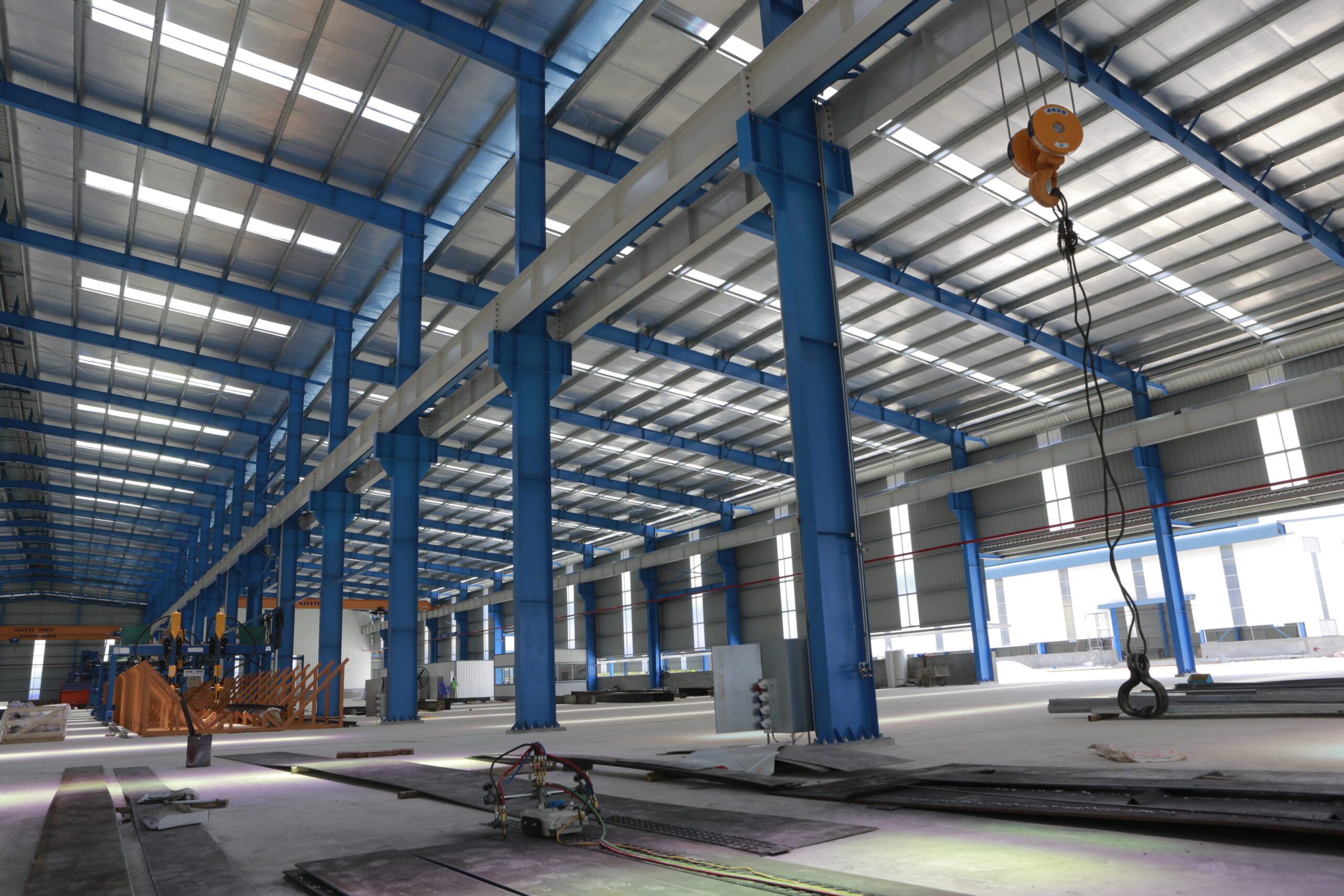
As Thailand’s logistics, e-commerce, and manufacturing sectors continue to expand, warehouse operations are rapidly evolving from conventional storage facilities into highly automated distribution centers. Businesses are increasingly investing in automation technologies to improve throughput, optimize space utilization, reduce labor dependency, and enhance inventory accuracy.
Modern warehouse projects are no longer designed solely around storage capacity. Instead, automation systems such as Automated Storage and Retrieval Systems (AS/RS), conveyors, robotics, and Automated Guided Vehicles (AGVs) are becoming central elements of warehouse planning. These technologies impose new requirements on building height, floor loads, structural systems, and layout optimization.
For developers considering PEB warehouse solutions or planning temperature-controlled facilities, designing for automation from the beginning can provide significant operational and financial advantages.
Why Automated Warehouse Design Is Reshaping Logistics Construction in Thailand
Thailand’s logistics sector is experiencing strong growth driven by:
- E-commerce expansion
- Cold chain logistics development
- Manufacturing supply chain modernization
- Rising labor costs
- Demand for faster order fulfillment
Traditional warehouses are often limited by manual operations and inefficient space utilization. Automated facilities enable companies to maximize storage density while improving speed and accuracy.
As a result, warehouse design today involves much more than arranging racks and storage areas. Modern facilities must integrate:
- Warehouse Management Systems (WMS)
- Robotics and automation equipment
- Conveyor systems
- High-density storage solutions
- Future expansion capabilities
This transformation is reshaping logistics construction throughout Thailand.
What Is an AS/RS Automated Storage System and How Does It Change Building Height and Floor Load Requirements?
An Automated Storage and Retrieval System (AS/RS) is a high-density storage solution that uses cranes, shuttles, and software-controlled mechanisms to automatically store and retrieve products.
Compared with conventional racking systems, AS/RS facilities require specialized building considerations.
Increased Building Height
High-bay warehouses may exceed 20–40 meters to maximize vertical storage capacity.
Higher Floor Loading
Storage racks and automated cranes generate concentrated loads that require stronger floor slabs and foundations.
Reduced Aisle Width
Automated systems allow narrower aisles, increasing storage efficiency.
Precise Structural Alignment
Rack systems and automation equipment require strict dimensional tolerances.
These factors make early coordination between structural, architectural, and automation engineers essential.
Structural Steel Design Considerations for Conveyor Lines and Robotic Systems
Modern automated warehouses incorporate extensive material handling systems that influence building design.
Typical systems include:
- Conveyor lines
- Robotic picking systems
- Sorting equipment
- Mezzanine platforms
- Automated packaging systems
Structural steel frameworks offer several advantages:
Flexible Layout Planning
Steel structures provide wide, clear spans that simplify equipment arrangement and layout, and optimize machinery
Easy Equipment Integration
Additional support for conveyors and robotics can be incorporated into the structural design.
Future Expansion Capability
Steel buildings can accommodate future automation upgrades with minimal disruption.
Reduced Structural Obstructions
Large column spacing improves operational efficiency and material flow.
These characteristics make PEB warehouse structures highly suitable for automated logistics facilities.
Floor Flatness, Tolerance Standards, and Slab Design for Automated Guided Vehicles (AGVs)
AGVs and autonomous mobile robots rely heavily on floor quality to ensure accurate navigation and reliable operation.
Important floor requirements include:
Floor Flatness and Levelness
Uneven surfaces can affect AGV performance and increase maintenance requirements.
Slab Thickness and Reinforcement
Floor slabs must withstand repetitive dynamic loads and concentrated wheel loads.
Crack Control
Excessive cracking can disrupt automated vehicle movement.
Vibration Performance
Stable floor systems improve precision for robotic operations.
International standards such as F-number tolerances are often specified for automated warehouse floors to ensure long-term operational reliability.
Fire Suppression, Racking Clearance, and Building Code Compliance in Automated Warehouses
Automated warehouses often feature higher storage densities and taller racks, increasing the importance of fire protection and regulatory compliance.
Critical considerations include:
Fire Suppression Systems
- ESFR sprinkler systems
- In-rack sprinklers
- Smoke detection systems
Racking Clearance
Proper spacing between racks and building components is required for maintenance and fire safety.
Emergency Access
Building layouts must provide access for personnel and emergency response.
Compliance with Local Regulations
Facilities must satisfy building codes, fire protection standards, and industrial safety requirements.
Proper coordination between warehouse design and safety engineering is essential for obtaining approvals and ensuring operational reliability.
Cost-Benefit Analysis of Building for Automation from Day One vs. Retrofitting Later
Many companies initially construct conventional warehouses and add automation later. However, retrofitting often introduces operational challenges and additional costs.
Building for Automation from Day One
Advantages include:
- Optimized building height and column spacing
- Proper floor slab design
- Integrated electrical and control infrastructure
- Lower long-term modification costs
- Better operational efficiency
Retrofitting Existing Facilities
Challenges include:
- Structural limitations
- Production interruptions
- Additional reinforcement requirements
- Higher installation costs
- Reduced layout flexibility
Although automation-ready facilities may involve higher initial investment, they typically deliver better long-term ROI and greater scalability.
Automated Warehouses and Temperature-Controlled Logistics
The growth of the food, pharmaceutical, and cold chain industries is driving demand for temperature-controlled warehouses integrated with automation.
Modern temperature-controlled warehouses combine:
- AS/RS systems
- Automated conveyors
- Refrigeration systems
- WMS platforms
- Real-time monitoring
Designing these facilities requires close coordination between structural engineering, refrigeration systems, and automation technologies to maintain product quality and operational efficiency.
Summary
Automation is transforming warehouse construction in Thailand. Modern facilities require much more than storage space—they must support AS/RS systems, conveyor lines, robotics, AGVs, and future expansion.
By integrating automation requirements into the early design phase, businesses can optimize operational efficiency, reduce labor dependency, and improve long-term competitiveness. Combined with flexible structural steel systems and PEB warehouse solutions, automated warehouses provide a scalable foundation for the next generation of logistics infrastructure.
AS/RS (Automated Storage and Retrieval System) is a high-density automated storage solution that uses computer-controlled equipment to store and retrieve products efficiently.
AGVs require highly level floors to ensure accurate navigation, minimize wear, and maintain operational reliability.
Steel structures provide wide spans, flexible layouts, and easier integration with conveyors and robotic systems.
Yes. Building for automation from day one reduces future modification costs and improves long-term efficiency.
Yes. Automation technologies are increasingly used in cold storage and temperature-controlled warehouses to improve efficiency and inventory management.