

Floor systems are one of the most critical components of any industrial building, whether it is a factory, warehouse, or multi level facility used for production and storage. A floor does more than simply support the weight of concrete and structural elements. It must also carry machinery loads, accommodate building services, and allow for future layout changes as the business grows.
In Thailand, project owners and engineering teams typically choose between traditional cast in place reinforced concrete slabs, precast systems such as Hollow Core Slabs, and Truss Deck systems. Truss Deck is a steel based floor system designed to reduce concrete volume and shorten construction time. One solution increasingly specified for industrial projects is SP Deck by SEICO Thailand. It is developed around the Truss Deck concept, with a strong focus on factory controlled design and manufacturing quality.
This article walks you through a practical comparison of industrial floor systems from a real world perspective. It covers structural performance, load capacity, building services integration, long term cost considerations, and maintenance. The goal is to help you select a floor system that aligns not only with initial budget targets, but also with your long term operational and business plans.
A Brief Overview of Industrial Floor Systems
Before selecting a Truss Deck solution or SP Deck by SEICO, project owners should understand the main types of floor systems commonly used in industrial buildings in Thailand. Each system has a different construction approach and performance profile, which directly affects project timelines, total cost, and future flexibility.
Cast in Place Reinforced Concrete Slab (RC Slab)
This is the traditional method that relies on formwork and supporting beams before concrete is poured on site. Its main advantage is design flexibility. It can be shaped to fit complex building layouts and can handle very high point loads, making it suitable for heavy machinery and concentrated loading areas. However, the process is time intensive. It involves installing formwork, placing reinforcement, pouring concrete, and waiting for proper curing, which can delay the overall building handover.
Hollow Core Slab (HCS)
HCS panels are precast concrete slabs manufactured in a factory and installed on site. Their key benefit is speed. Installation is fast and quality is generally consistent due to controlled factory production. This system works well for buildings with repetitive layouts and standardized column spacing. The main limitation is flexibility. Routing building services and making future layout changes can be more complex because the internal structure of the slab is fixed during manufacturing.
Truss Deck System
Truss Deck is a steel based floor system that acts as both permanent formwork and a structural component. It reduces concrete volume and the number of supporting beams, often resulting in more open space and faster construction.
For industrial projects in Thailand, SP Deck by SEICO is developed based on the Truss Deck concept, with a strong emphasis on factory controlled design and production. This ensures consistent component dimensions and connection points, making it suitable for industrial buildings that require speed, accuracy, and long term adaptability.
In summary, no single floor system is the universal best choice for every project. The right solution depends on how the building will be used, how quickly it needs to become operational, and how the business plans to grow over time. This leads to an important question: when is Truss Deck the right choice, and when should alternative systems be considered?
When to Choose Truss Deck and When to Consider Alternatives
Although Truss Deck systems are becoming more popular in industrial construction, they are not the ideal solution for every project. A sound decision starts with a clear understanding of actual usage, required load capacity, and future modification plans.
Situations Where Truss Deck Performs Well
For projects that prioritize construction speed and functional flexibility, Truss Deck systems can significantly reduce on site work. The steel truss serves as both formwork and structural support. When combined with SP Deck, which is manufactured under factory controlled standards, project owners benefit from consistent component sizes and predictable connection points, making installation more reliable and easier to schedule.
Buildings with mezzanine levels or multi tier floor systems, such as warehouses, manufacturing plants, and storage facilities, often gain practical advantages. Electrical conduits and piping can be routed through the open truss structure, reducing the need for post construction drilling and structural modification. This makes long term expansion and layout changes more manageable.
In projects with strict timelines, such as industrial estates and logistics centers, faster floor construction and reduced concrete curing time can directly impact building handover dates and business cash flow.
Situations Where Traditional Systems May Be More Suitable
In some cases, cast in place slabs or precast systems remain the better option. This is especially true for buildings with extremely high point loads from large scale machinery or areas where vibration control is critical, such as precision manufacturing zones that require a very stable floor surface.
For buildings with unique architectural forms or non standard column grids, traditional systems often provide greater design freedom. Formwork and reinforcement can be adapted more easily to match complex shapes and layouts.
Comparison of Truss Deck, RC Slab, and Hollow Core Slab (HCS)
Comparison Criteria | Truss Deck (General System) | RC Slab (Cast in Place Reinforced Concrete) | Hollow Core Slab (HCS) |
System Concept | Steel truss acts as both structural support and permanent concrete formwork | On site formwork and reinforcement with concrete poured in place | Precast concrete panels manufactured in a factory and installed on site |
Construction Timeline | Faster, as the steel structure is installed first and concrete can be poured immediately | Slower, due to formwork installation and concrete curing time | Fast installation, but requires careful logistics planning for transport and lifting |
Structural Weight | Moderate overall weight, reduced concrete volume due to steel truss support | Heavy, as it is a solid concrete system | Lighter than RC Slab because of hollow core design |
Point Load Capacity | Suitable for general industrial loads, depending on truss design | Excellent for very high point loads and heavy machinery | Limited point load capacity, may require structural reinforcement |
Column Spacing and Design Flexibility | Medium to long spans, adaptable within steel framing systems | High flexibility, easily adjusted to architectural design | Limited by standard panel sizes from the factory |
Electrical and Mechanical Services Routing | Services can run through the truss openings, reducing post construction drilling | Requires embedding or drilling, increasing service installation work | Limited options for cutting or embedding services |
Future Expansion Suitability | Easier to add mezzanines or extend floor areas | Possible, but requires full structural reanalysis | Difficult, as panels are fixed in size and configuration |
Quality Consistency | Depends on manufacturing standards and installation team | Heavily dependent on on site workmanship | High consistency due to factory production |
Typical Applications | Warehouses, factories, mezzanine floors, multi level industrial buildings | Heavy machinery plants, specialized industrial facilities | Buildings requiring fast installation and standardized layouts |
Key Differences Between General Truss Deck Systems and SP Deck by SEICO
In the industrial construction market, Truss Deck is a general term for steel based floor systems that reduce concrete volume, extend spans, and accelerate construction. These systems are offered by multiple suppliers, each with different materials, truss configurations, and quality control standards based on their own processes.
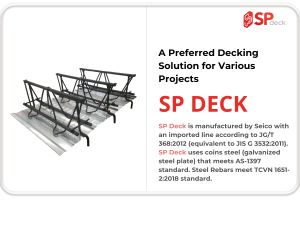
SP Deck by SEICO follows the same fundamental Truss Deck concept, but it is developed as a complete system solution rather than just a structural component. SEICO defines engineering design parameters, factory production standards, and installation guidelines that remain consistent throughout the project, from structural planning to on site delivery and inspection.
The main distinction is not the visual form of the floor system itself, but the level of quality consistency and technical data accuracy. With general Truss Deck systems, project teams often need to verify specifications and calculations on a case by case basis to ensure that materials and installation match actual load and usage requirements.
SP Deck is designed to operate under a unified system specification. This includes span design, load capacity, beam layout, and service integration planning. As a result, designers and project managers can better predict total cost, construction timelines, and long term expansion potential with greater clarity and confidence.
Conclusion: Aligning Your Floor System with Structural and Business Strategy
An industrial floor system is not just a structural element. It is part of a long term operational strategy. It affects how quickly a building becomes operational, how well it supports machinery and production, and how easily it can adapt to future expansion or layout changes.
Cast in place RC slabs are well suited for projects with extremely high point loads, specialized structural demands, or unique architectural forms. They offer strong design flexibility, but usually require longer construction timelines and higher on site labor and time costs.
Hollow Core Slabs work well for buildings with repetitive layouts, standardized column spacing, and a strong need for fast installation. Factory production helps maintain consistent quality, but future service routing and structural modifications can be limited.
Truss Deck systems and SP Deck by SEICO are well suited for industrial buildings that prioritize construction speed, open floor space, efficient service integration, and long term expansion planning. For projects that view the floor system as a coordinated structural solution rather than a standalone component, SP Deck provides standardized design and factory controlled production. This allows project teams to forecast cost, timeline, and structural performance more consistently throughout the building’s lifecycle.
In practice, floor system selection should not be based on initial price alone. It should reflect how the building will be used, the level of load it must carry, the complexity of building services, and the long term direction of the business. When structural planning and business strategy are aligned, the chosen floor system becomes a long term performance asset rather than a short term construction cost.
Consult on the Right Floor System for Your Project
If you are planning to build or expand a factory, warehouse, or industrial facility and want to evaluate which floor system best fits your structure, operational needs, and long term budget, SEICO Thailand’s engineering team is ready to provide project specific technical consultation.
Request expert advice on SP Deck and industrial floor systems.